Featured

It’s the Townships. With all the grit you remember from the good old days

I have always been a storyteller. Came from a family of storytellers. Stories are what make us who we are.

And yet, when I looked to the world of stories and books, I rarely saw myself reflected in the stories of others. And when I looked back at what a lot of people think of as “the good old days,” I came to the realization that if I was going to tell stories from an era, I had to be true to that era.

The Eastern Townships of my youth, in the 1970’s and 1980’s, contained all of the bucolic beauty you might expect. But it was also a hardscrabble place, filled with political turmoil, racism, dirt and grit.

Welcome to Townships Noir

On this site you’ll see much more than just me trying to sell books. News, author stuff, local history and folklore, maybe even some fresh short fiction. I plan to be experimenting, so please come back often.

You never know what you’ll find.

My Austin Mini and the vanishing joys of the analog driving experience

It was small, rusty, unreliable and a bit ridiculous, but it opened up my life in so many ways.

I was sitting in my garbage truck the other day at an intersection when I saw an approaching Tesla. The car came to the corner and executed a right turn. I found the fact the driver wasn’t touching the steering wheel rather disconcerting.

I am a driver. I was driving tractors before I could ride a bicycle, and as a farm kid cycled many, many miles to get pretty much anywhere. When I turned 16, I got my hands on a metallic brown 1978 Austin Mini.

Back in the days when Britain still made things, Sir Alec Issigonis, an engineer that believed mathematics to be “…the enemy of every truly creative man,” created the Austin Mini. In 1959, no one had ever seen anything like it before. Tiny, surprisingly sporty, it boasted front wheel drive and a transverse mounted engine. Much smaller than the modern Mini, it held to the road like it was on rails. Not the fastest in a straight line, the Mini Cooper S nevertheless won the Monte Carlo Rally in 1964, 1965 and 1967 because of its phenomenal handling. I didn’t do much racing, except against a buddy who drove a two door Ford Pinto station wagon. I could lose him in the curves every time. The Austin Mini would stay in production until 2000, with over 5 million of them being sold around the world.

Sadly, I don’t have much for photos of my Mini. It’s basically this, but with a big gold Jeep bumper on the front.

By the time I got my mini in 1984, its best days were quickly disappearing in the rear-view mirror. The previous owner had beaten it up pretty badly, and the front bumper had once served on the front end of a Jeep. The ceiling was adorned with brown shag carpet, and before I took possession, he had removed six of the eight speakers and the radio. I couldn’t handle the shag, so the first thing I did when I got it was to rip it out. Bad move: he used contact cement, so I was left with a snot-like residue all over the ceiling.

It was also unreliable. The gas gauge didn’t work, the brakes were always a bit dodgy, and the lights would randomly stop working. It took all your senses to operate, as you watched the gauges that did work, listened for odd noises, and be on the alert for bad smells. If the smell wasn’t generated in the passenger seat, it could have been burning brakes, singed wiring, or the sweet smell of boiling antifreeze.

That learning process put me on good terms with my mechanic. Who would later become my boss, friend, mentor. A relationship that endures to this day.

It took all my attention to keep my Mini on the road. That’s the way it used to be for any motor vehicle. In my opinion that’s the way it should be still. Instead, modern automobile design is focused on separating the driver from the machine and losing a little something in the process.

Besides driving being the most dangerous thing most of us ever do, it’s also a place to enjoy certain freedoms. In a world where we are tied to subscriptions for our music, television, Internet, our ability to contact loved ones, or are bound to be in line for any number of things, the modern vehicle frees us to move about our environment, go where we want, when we want, how we want. It’s a rare moment of liberty in the day-to-day.

For a person who battles anxiety like I do, driving has been a coping mechanism. It’s an opportunity to have a moment where no one can ask anything of me. Don’t bother me, I’m driving. And in the days before cell phones, it was a time where one could, justifiably, be unreachable.

Here’s an exercise for you: Leave your phone on the counter for a few hours and go for a drive. See how that makes you feel. Feels pretty good, eh?

Instead, we live in a world where leaving your home without your cell phone is akin to going out with one shoe on. And then your car immediately pairs to your phone. In the pickup trucks at my work the screen tells me to connect my phone. Even if I don’t want to. You can read your text messages on the giant screen, plan your route, call someone.

But wait! Distracted driving is supposed to be a bad thing. Don’t let yourself be distracted by that big screen that tells you to connect your phone. And there’s so much sound deadening material that you can’t listen for odd noises, and the odd smells get removed by the cabin air filter. You’re going to the store in a space shuttle.

A space shuttle that tracks everything you do. Are your eyes open? Are you too close to the yellow line? Do you need to stop for a coffee? LEAVE ME ALONE FFS!

Increasingly cars, especially the ones with driving assists, have become more like appliances, the act of driving incidental. Like it is for those ride share people. If there’s a motorist who drives like they are lost, or don’t know the rules of the road, or simply don’t seem to care, chances are there’s a ride share logo on the door. For these people driving isn’t a moment of freedom, it’s an incidental act required to get somewhere. A necessary evil. They are missing out.

And now there’s the increasing use of Flock cameras. Look that up sometime. These cameras automatically log your licence plate, vehicle make, model. They even read your bumper stickers. And it all gets logged to a server farm somewhere for the authorities to look up whenever they feel like it. It’s common in the US, and apparently starting to make an appearance here in Canada. Echoes of 1984.

Freedom and a social life

For all its quirks (like the eight-track player I installed where you had to keep a hand on the tape to keep it playing at the right speed), I loved my Austin Mini. It gave me a social life. Not every teenager has a car, and parties could be hard to get to. It might not have been very impressive, but it got me and my friends to where the action was. I wasn’t cool, but I was becoming known.

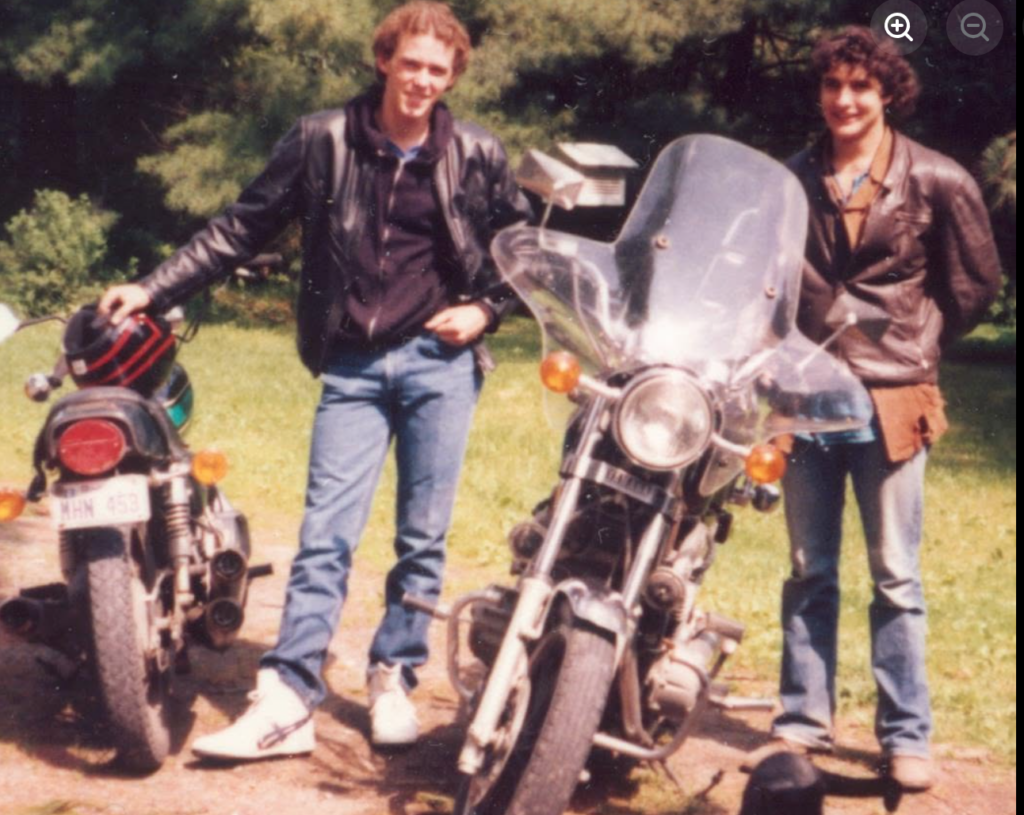
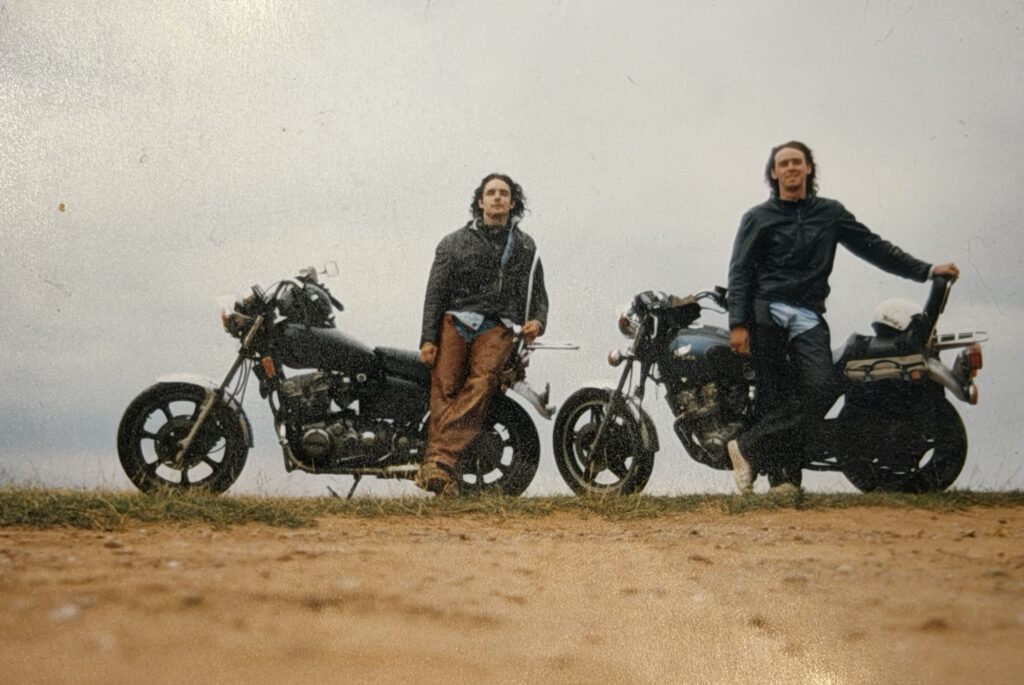
The cool came later. When I got a motorcycle.

I think every new driver should start with a cheap, rundown car. No screens, no bells and whistles. No distractions. Analog driving. The inevitable breakdowns will teach them how vehicles work, and if they bump into something, they learn to avoid similar mistakes in the future. Put the phone in the glove box and go.

Because getting there should be half the fun.
Everybody loves to be buttered up, even writers

Sure, they might be phishing, but I’m fully willing to let them compliment my talents. Even if they haven’t read a word.

In these waning days of a long, cold winter, sometimes I need a little pick me up. And that’s when I check my email. Hmm… The old Inbox is looking good today. A few samples:

“My name is Anabel Brooks, the curator of the Good Morning America Book Club.

As we prepare our Valentine season reading feature, I wanted to personally reach out. We’re highlighting a select group of authors and introducing their work to our community of over 151,000 engaged readers, and your work stood out during our selection process.”

Well, isn’t that nice. Good Morning America, a top US morning show has discovered little old me. Let’s scroll to my next email, this from one Gilmore Schaffer:

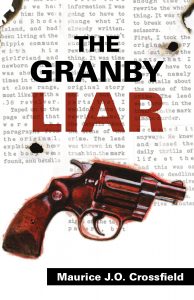
“I’m reaching out because The Granby Liar struck me as the kind of novel that lingers with a reader long after the final chapter—not because it shouts, but because it observes carefully, trusts the intelligence of its audience, and allows tension to unfold with restraint.”

Gilmore is obviously insightful, with discerning taste in elegantly written crime novels. Man, I’m on fire.

“Dear Author Maurice,

My name is Angela Morrettis, and I serve as the Member Relations Lead Coordinator for Lucy’s Book Club, a 4.9★-rated Instagram reading community of over 15,000 engaged readers who meet monthly to read, reflect, and share meaningful conversations around books.

For our January 23 National Reading Day gathering, our members would be excited to read and discuss one of your books. We believe your work would resonate deeply with our audience and spark thoughtful dialogue during the session.”

Wow, 15,000 engaged readers. Throw in a few disengaged readers and my book sales will go through the roof.

“My name is Karin D, and I lead the Wellington City Book Club, the premier literary community based at the iconic Circa Theatre in New Zealand’s capital. I am reaching out because The Granby Liar has been officially shortlisted for our 2026 Author Spotlight.”

Oh my, New Zealand. I had no idea I was an international phenom. I really love it when a reader from the other side of the globe connects to my deep love of Townships storytelling.

Wait, there’s another email from Veronica Clara. I bet she really understands what I’m getting at:

“The way you explore the many layered, sometimes conflicting ideas around tzedakah, its spiritual meaning, its human implications, and its role in wealth, repentance, and redemption is both profound and deeply moving. Your careful comparison of the Babylonian Talmud and the rabbinic compilations of the land of Israel brings a richness and emotional depth that made your work feel incredibly alive and relevant.”

                  Okay, I wasn’t expecting that.

                  Welcome to the modern life of the small name author. It seems that when it comes to scams, the con artists are really scraping the bottom of the barrel. It’s enough to make one long for the days of the Nigerian Spam Scam, where a stranger asks if you would give him your banking information so he can move his millions out of the country, and in return he’ll reward you most generously.

                  Yes, it seems the Nigerian princes have all moved away, your Microsoft Outlook is up to date, and your nephew has gotten his bail money. So now it’s down to the ink-stained wretches to support the online scamosphere. Limited time, get back to us quickly, only a few spots left. You too can be as successful as Louise Penny.

                  Of course, there’s a flaw in all of this, one that seems to have escaped the keyboard kings of the seedy underbelly of the Internet: YOU’RE TRYING TO GET MONEY OUT OF WRITERS. Toiling in obscurity, that’s kind of our thing, and we have the bank balances to prove it. We work on laptops that are older than our college age children, shivering in our pilled sweaters as we try to stave off the winter chill. A scant few make the big leagues, sparking hope in the rest of us. And there’s a lot of us.

                  But of course, as writers we aren’t just broke, we’re also suckers for a good compliment. Reading things like “I was struck by the depth of your storytelling,” or that my work “resonates with readers,” really warms the heart.

                  Thankfully, I have a deep sense of cynicism, honed by years of working as a newspaper reporter and magazine writer. When everyone is out to get you, paranoia is just common sense.

                  So no, I won’t be part of the Good Morning America Book Club anytime soon. I won’t be the featured author for the 2026 Author Spotlight. But I still might take a shot at comparing the Babylonian Talmud and the rabbinic compilations of the land of Israel. Just dig in, see where it goes.

                  Time to dust off my Old Testament.

Albert Lisacek: A look back at Canada’s toughest cop

Raised on Montreal’s mean streets, he was a real life action hero.

If I ever decide to write a novel about a tough-as-nails cop who didn’t mind breaking a few rules to bring the bad guys to justice, I think I’d have to base him on the Sûreté du Québec’s own Albert Lisacek.

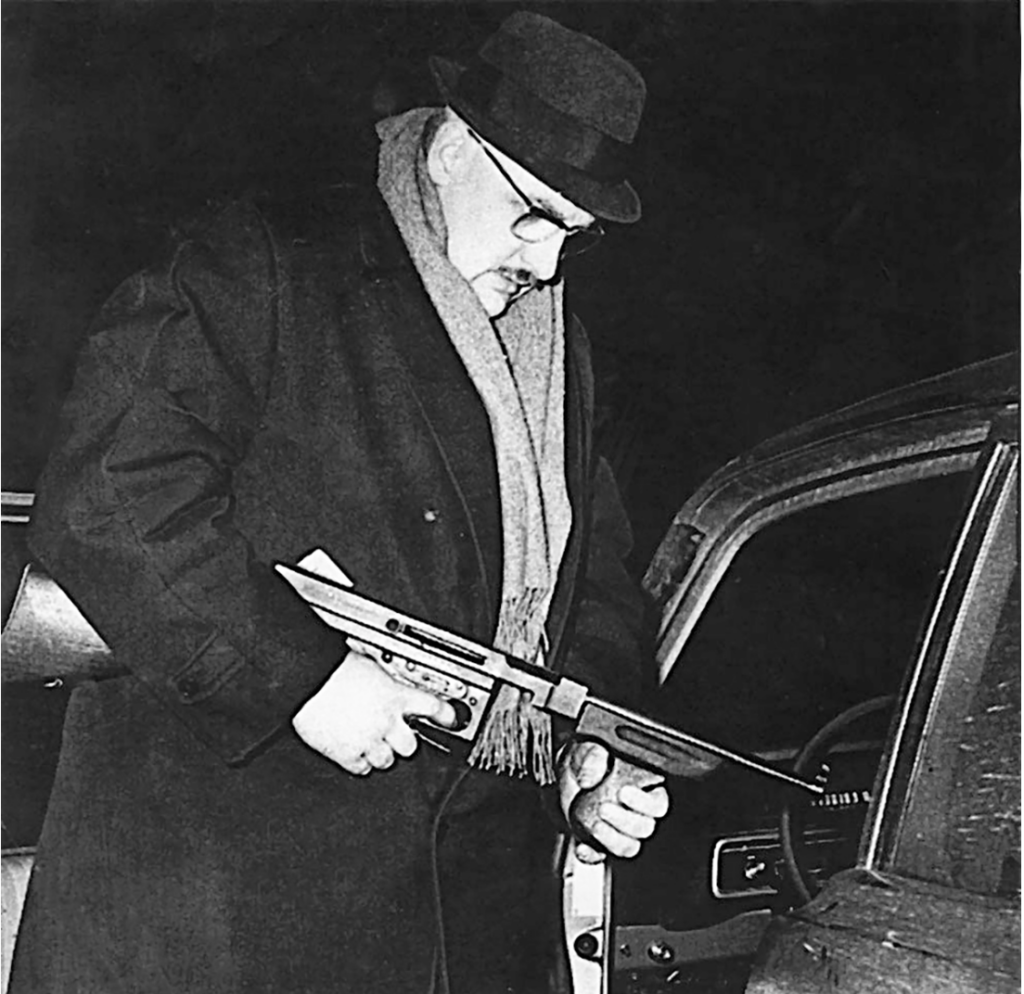
Albert Lisacek, seen here with his beloved Chicago Typewriter.

This guy had all the qualities you’d look for in a hard boiled, film noir cop. Born in 1933 in Montreal’s Mile End to Czechoslovak immigrant parents, Albert came by his physical attributes honestly. His mom, who was five-foot-eleven, gave birth to her three children at home, no doctor required. And dad was a former strong man in a Slovenian circus, who worked in shipyards and as a night watchman when he came to Canada.

Life in Montreal was rough in those early years, and Albert was often hounded by the neighbourhood bullies. One day, while being chased, 15-year-old Albert hid out in an old lady’s apartment until they went away. That was the moment he decided he wanted to become a police officer.

Fast forward five years and our young hero has been working out, tipping the scales at 250 pounds and standing at a respectable six foot-two. This made him ideal for his job as a bouncer at a St. Catherine St. night club. After some time working as a private detective, Lisacek joined the SQ at the tender age of 23.

His first job was guarding the jail cells at police headquarters. When one inmate in a group of eight got a little too mouthy, Lisacek went into the cell, locking the door behind him. He then proceeded to slap around inmates with his giant hands until the culprit was given up by the others.

Before long Montreal’s criminals were calling him “Dirty Albert.” This, more than 20 years before Clint Eastwood made Dirty Harry a household name. His colleagues called him “Little Albert,” and later “Kojak” when he shaved his head.

By 1961 Lisacek was promoted to detective. “I was good at getting rid of the bad people,” he told a reporter years later. Two years later he was a member of the SQ’s hold-up squad, where he became known for bringing his own Thompson submachine gun on raids. If you’ve ever seen a gangster movie set in the Prohibition era, you’ve seen a Tommy gun. Also known affectionately as a Chicago Typewriter. It spat out large, heavy .45 calibre slugs that could really make a mess. I really don’t think cops could get away with that sort of thing today.

So Lisacek is on the holdup squad just as bank robberies are on the rise. Before long Montreal will be given the dubious title of North America’s bank robbery capital. And by the mid 1970’s the city’s murder rate is three times what it is today. There’s a lot going on, and Lisacek is in the midst of it all.

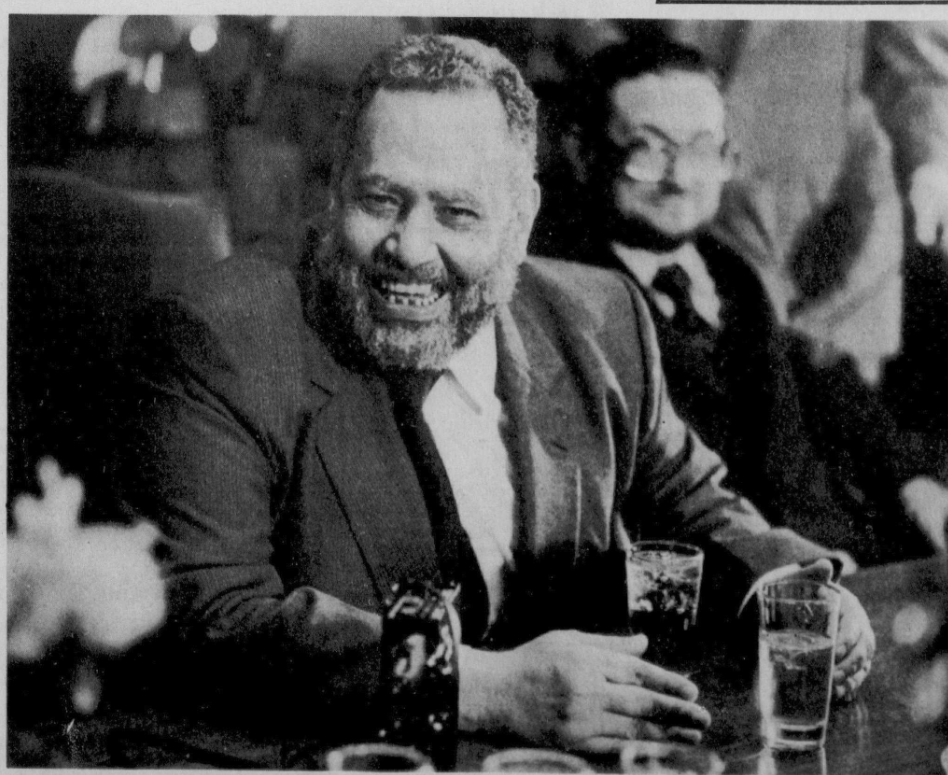
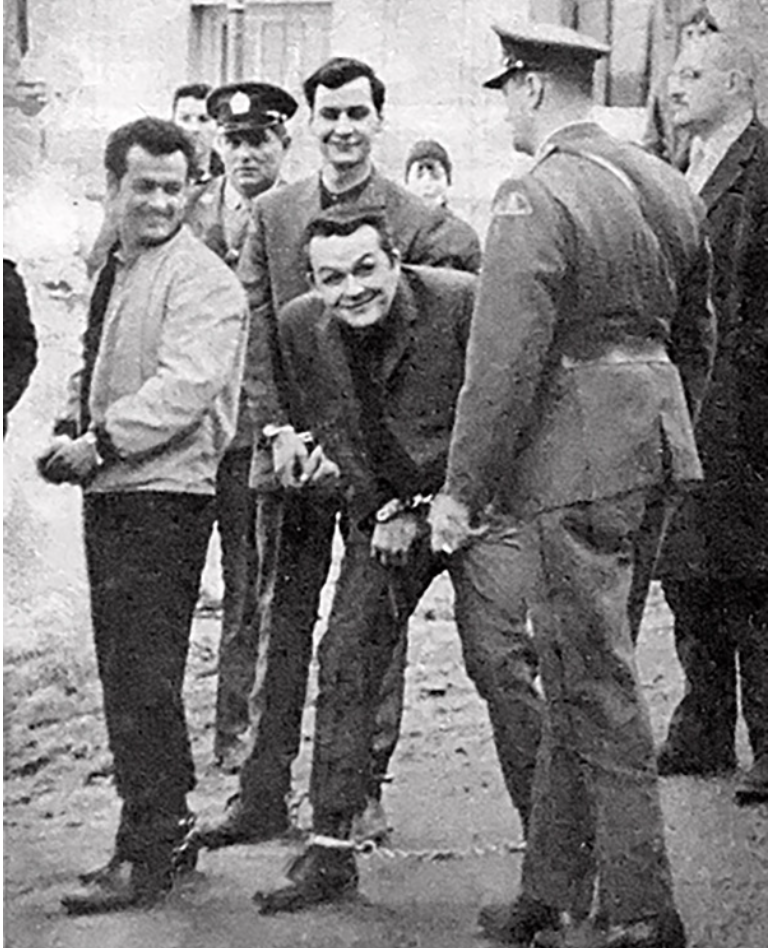
In 1969 Lisacek arrested Richard “The Cat” Blass for a bank robbery in Sherbrooke. Blass was a very, very bad man who had survived four assassination attempts and escaped from prison three times. At one point during the trial Lisacek saw a man from the audience lean forward, seemingly to give Blass something. Lisacek grabbed the man, dragged him out of the courtroom and smashed his face into the elevator door.

Richard “The Cat” Blass, seen here smiling for the cameras, was about as bad as it gets. Lisacek can be seen at the far right.

Man on the scene

Lisacek became Quebec’s most notorious cop, often at the centre of the latest news on Quebec’s crime scene. He was there in October 1970 when the body of Pierre Laporte, Quebec’s deputy premier, was found, murdered by the Front de libération du Québec. Two years later, while intervening in a robbery, the big man gave chase to three suspects. One of them ended up with, uh, his testicles shot off. In another case, a robber was running so hard to get away from the big man that he lost his shoes.

In 1975 Lisacek was on the trail of Blass once again. Blass had escaped custody, and while on the lam he locked 13 people in the beer storage room at the Gargantua Bar in Montreal, and then set the building on fire. All 13 died in the blaze.

The pursuit led Lisacek and his colleagues to a chalet in the Laurentian town of Val David. With Blass cornered in a bedroom, Lisacek agreed to let Blass put his pants on before coming out. When Blass stepped out of the room, the police opened fire. Blass was shot 27 times.

Lisacek, who would later state that what appeared to be a weapon in Blass’s hand was nothing more than a sock, never fired a shot.

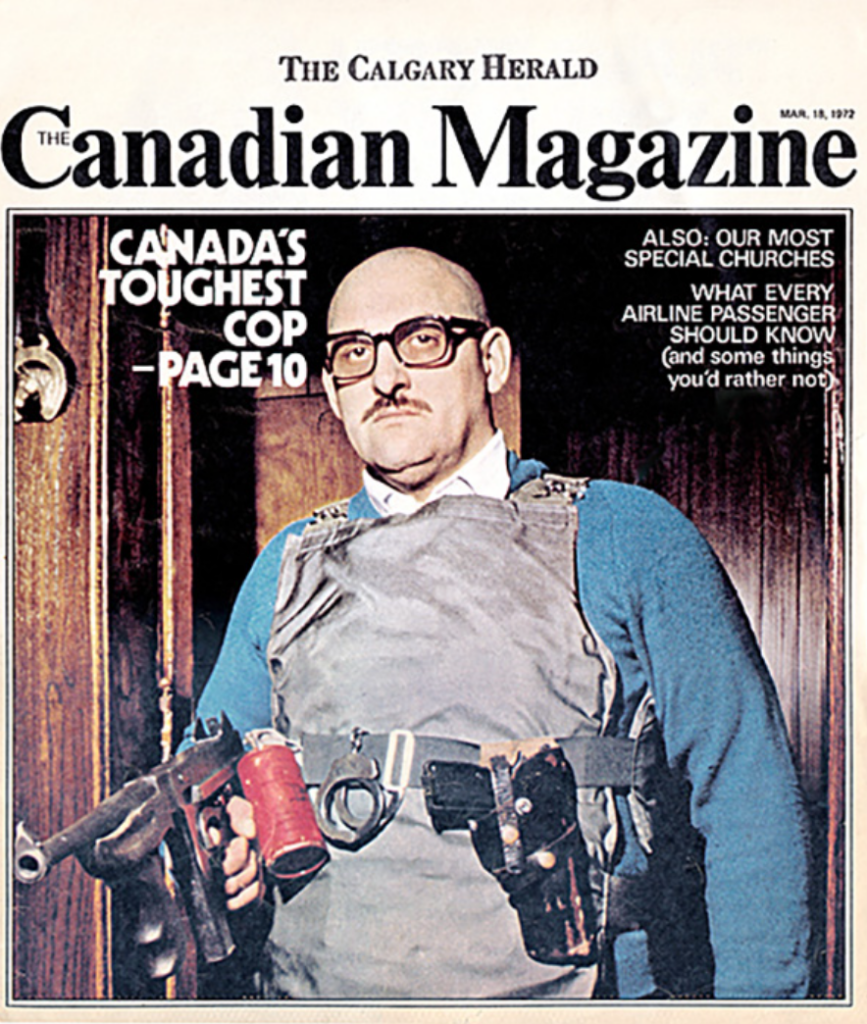
A study in contrasts: Note the other headlines.

Being at the heart of so much bloodshed caused Lisacek no shortage of grief at the hands of his SQ superiors. He was eventually moved to a desk job, his Chicago Typewriter retired. In 1981, at the age of 48 and with knee problems that made it hard to get around, Lisacek took early retirement.

His home life proved to be much quieter than working the mean streets. Devoted to his wife and dogs, he passed his days watching action movies and collecting John Wayne memorabilia. His beloved Claudia died in 1999, and he later remarried a cousin by marriage, Jacqueline Richer, who he doted on.

“He had a very tender heart,” said Richer. “When he saw there was no justice, he wanted to make justice.”

In 2012 Albert Lisacek, once the toughest cop in Canada, died of colon cancer. He was 79.

Quebec hasn’t had many homegrown action heroes on the silver screen. But they did have one in real life.

A look back at the brutality of the Hells Angels Lennoxville Purge

It was the party that laid the groundwork for a gang war that would shake Quebec for more than 15 years

By Maurice Crossfield

I missed an anniversary earlier this year. No, it’s not really one that should be celebrated. March 2025 marked the 40th anniversary of the Lennoxville Purge, in which five Hells Angels were gunned down at a party at the gang’s clubhouse and ultimately set the stage for the second Quebec Biker War.

A little background first: Back in the 1970’s Sherbrooke was the home of rival gangs the Gitans (formerly the Dirty Reich), and the Atomes. They were basically hooligans who rode motorcycles, did a lot of drugs and dabbled in a few organized crime activities. And when they crossed paths, things often got ugly, leading up to the so-called Night of the Long Knives in March 1974, in which the two gangs got into a rumble, which spilled over into various parts of the city, including in the emergency room of the St. Vincent de Paul hospital. By the end of the night two Atomes were dead, and several bikers were injured. Policing being what it was, no one went to jail for any of it.

In the years afterwards the violence became more sporadic, and it seemed the gangs were fading. Slowly the Gitans picked off or patched over the remaining Atomes.

Provincially, there was a Montreal gang called the Popeyes, who were itching to get into the big leagues, so in 1977 they tossed out their gang colours and became the very first Hells Angels chapter in Canada. They then went to war with the Outlaws in what became known as Quebec’s First Biker War, and by 1984 they had chased the Outlaws out of Quebec. Not long afterwards the Gitans, now the only motorcycle club in Sherbrooke, became Hells Angels as well.

By this point the Hells were getting serious about business, building up their network of drug dealers and establishing ties with the big boys of organized crime, like Montreal’s West End Gang and the mafia’s Rizutto family. Their credo was simple: less partying and general hooliganism and more business.

But the Laval chapter, also known as the North Chapter, apparently didn’t get the memo. They still liked having fun and causing trouble. But when they started using drugs that they were supposed to sell, and then started skimming the profits, the Montreal chapter saw a problem. Something needed to be done. How about a party in Lennoxville?

When eight members of the Laval chapter showed up at the Sherbrooke clubhouse (located just on the Lennoxville side of the line on Queen St.), they were welcomed inside. Then, with members of the Montreal, Sherbrooke and Halifax chapters present, five of them were gunned down. The remaining three Laval bikers were then made to clean up the mess and dispose of the bodies.

Years later, when I was working as a newspaper reporter, I got to see the inside of the bunker following a raid by the Sherbrooke Police. It was a rather unsettling feeling standing in the room where the massacre took place.

After the shooting, the five bodies were then put in sleeping bags and weighed down with cinder blocks and dumped into the St. Lawrence River near Sorel. Two of the Laval cleanup crew were forced into retirement, and the third was reassigned to the South, or Montreal chapter. Two weeks later another man, Claude (Coco) Roy, was shot by fellow gang member Michel (Jinx) Genest.

That was that. Until a fisherman in Sorel snagged a body in three months later. Sûreté du Québec divers found the rest, and the Lennoxville Massacre came to the public’s attention.

“At that moment (in 1985), the Hells Angels were doing a real cleanup to become a real criminal organization,” said André Cédilot, a reporter with the La Presse newspaper who covered organized crime at the time.

Eventually, out of the 41 people present at the Lennoxville Purge, five men were given life sentences for the murders. They were all were released on parole between 2004 and 2013.

But all was not well in the biker world. Most notably brothers Salvatore and Giovanni Cazetta decided to form the Rock Machine in 1986, rather than join the Hells Angels. Initially the two gangs opted to coexist. Until one of the Cazetta brothers got nabbed in the US while trying to smuggle 200 kilos of cocaine and went to prison. The Hells decided the time had come to take over all street-level cocaine sales in Quebec.

The resulting bloodbath between the Hells Angels and the Rock Machine would last more than 15 years. Through the many twists and turns, the final body count was 162 dead, including several innocent bystanders. There were 84 bombings and over 130 cases of arson. Though the Rock Machine joined forces with the Bandidos, most of them ended up dead or arrested. The Bandidos imploded in 2006 following an internal massacre of their own in Shedden, Ontario.

The Hells Angels were targeted by police many times during the biker war, with raids, arrests, jail sentences, releases, bikers informing on bikers, you name it. In a 2009 operation 156 Angels were arrested in Quebec, New Brunswick and France. But in 2015 the charges against most of them were dropped, the judge deciding that things had dragged on too long.

From the mid 1990’s to the early 200’s, I got to cover a few biker-related cases. Like the raid I mentioned earlier, where I also got to see one of Sherbrooke’s SWAT team members easing his way towards the house, rifle at the ready, when one of the Hells guard dogs came up and licked his face.

And there was the humour of seeing the Evil Ones, a Hells Angels puppet gang, being dragged into court. Being primarily francophones, they called themselves the “Heevils Ones.” I got a kick out of seeing a group of guys who belonged to a gang that they couldn’t even pronounce the name of properly.

There were literally dozens of twists and turns in the biker war saga, of bikers turning informant, settling of accounts, and so on. Two provincial prison guards, Diane Lavigne and Pierre Rondeau, were murdered on orders from Hells Angels Nomad leader Maurice (Mom) Boucher. There were even plans to kill police officers, Crown Prosecutors and judges, but those fortunately didn’t pan out. Boucher was convicted 2002 of ordering the prison guard murders, and sentenced to life behind bars. He died of throat cancer in 2022.

The dust may have settled, but the Hells Angels are still out there. The clubhouse was torn down in 2021, and the organization is a little quieter these days, but they’re still out there, doing their thing. Taking care of business.

Justice served at the end of a noose

The hanging of William Gray was big news in Scotstown – though passed almost unnoticed everywhere else.


It always surprises me how much attitudes on various issues have changed over the years. Like how blasé the wider world was when Scotstown’s William Gray was hanged for murder in 1880.
“Hanged today – William Gray, the murderer of Thomas Mulligan at Scotstown, was hanged at Sherbrooke this morning. He was cool and collected to the last, and died protesting his innocence,” wrote the Quebec Daily Mercury on December 10, 1880.
That’s it. On page three, next to items about how electric lights were being tried out in New York City for the Christmas season, and the completion of the railway link between Sherbrooke and Lévis. Two pages after an ad for Chamberlain’s Eye Ointment.


But you can be sure it was a hot topic of conversation for the people of Scotstown. Life in the tiny, remote, predominantly Scottish settlement was tough, and everyone knew everyone. So, when Mulligan’s remains were found, people took notice.

Maintained his innocence
Here’s what we know from the court’s point of view: Gray, a labourer, went to Mulligan’s house for a drink on December 20, 1879. They probably spoke Gaelic, like many of the 20,000 Scots who lived in that end of the Eastern Townships at the time. Forced off their homeland during the Highland Clearances of the 1830’s and 1840’s, they clung to their language, culture, and each other as they tried to carve out new lives in a harsh environment. While most of those early settlers later moved away, Gaelic could often be heard in that part of the world well into the 20th century.
At some point during the booze-fueled visit things turned ugly, and Gray used an axe to murder Mulligan. Upon sobering up Gray feared he would face a murder charge, so he returned to Mulligan’s house the next day and set it on fire.
It was only on Christmas Day that neighbour Alexander Scott noticed he hadn’t seen Mulligan around, and decided to go check on him. What he found was the burned out remains of the cabin, and a horribly burned human body, apparently Mulligan’s.
Before long the authorities came to suspect Gray. They arrested him and during questioning he let it slip that he knew of Mulligan’s death even before Scott discovered the body. A search of Gray’s house revealed some furniture and personal effects belonging to the victim, total value $34. He couldn’t really explain himself.
The authorities (calling them police might be a bit of a stretch) also received a statement from another nearby resident, a Mr. F. H. White, who claimed that Gray confessed the murder to him.
Throughout all this Gray protested his innocence. His lawyer, Robert Short, alleged there was no legal proof the body was that of the victim, and that the calcified corpse gave no evidence as to cause of death. Crime scene investigation and forensics being what they were in Victorian rural Canada, the circumstantial evidence pointed to murder. A jury returned a guilty verdict on October 6, 1880, and Judge Marcus Doherty handed down the death penalty. Gray was sent to the Winter Street jail in Sherbrooke to await his fate.
He didn’t have long to wait. On December 10, 1880, less than a year after the murder, Gray was led up the stairs of the portable gallows set up at the Winter Street jail for the occasion, and John Robert Radclive, Canada’s first official executioner, carried out the deed. Gray struggled for six minutes, hanging for ten minutes in all, before being declared dead.

Unhappy hangman
While the hanging of a murderer was no more than a curiosity for the average newspaper reader, for Radclive it was serious business. He was known for being a conscientious and kind man in dealing with his subject matter, but there were a few botched jobs in there. Like when he would miscalculate how far the prisoner would have to fall for a quick death, resulting in prolonged choking (up to half an hour) or, in at least one case, ripping a woman’s head off.

Photo: The hanging of Stanislas Lacroix, March 21, 1902 in Hull, Quebec. Note people watching from utility poles. People can be a bit sick sometimes. (Image taken from Wikipedia)


It would be easy to write off Radclive as a state sanctioned murderer. But the fact is he suffered greatly for his chosen profession. He claimed to have overseen more than 200 hangings, and expressed deep remorse for his involvement in so many deaths later in life.
“I had always thought capital punishment was right, but not now. I believe the Almighty will visit the Christian nations with dire calamity if they don’t stop taking the lives of their fellows, no matter how heinous the crime,” he said. “Murderers should be allowed to live as long as possible and work out their salvation on behalf of the State.”
A traumatized Radclive died in Toronto at the age of 55 from alcoholism.

Shifting attitudes
By the time of Gray’s hanging, Canadian opinion on capital punishment had already begun to shift. In 1840 the execution of an innocent man in Windsor, Ontario, resulted in the abolition of the death penalty across the river in Michigan. On the Canadian side the laws were revisited after Confederation, with the offences punishable by death reduced to murder, rape and treason.
The idea of public executions in Canada dropped away as well, with the last public hanging taking place in Goderich, Ontario in 1869. Once again, the evidence could have, by today’s standards, pointed to any one of several people rather than the man who ended up feeling the bite of the noose.
I have never understood the idea of wanting to witness an execution. Yet the appetite remained, and in an archival photo of the execution of Stanislas Lacroix in Hull in March 1902, people can be seen clinging to utility poles, trying to get a view of the event. Human nature is strange sometimes.
The hangings continued, and between 1867 and 1976, some 710 people were executed by hanging in Canada. The last two were carried out at Toronto’s Don Jail in 1962, with most murderers receiving life sentences instead. Shortly afterwards a moratorium was placed on the death penalty, and it would take another 13 years to finally make it a thing of the past.
Today almost no one remembers William Gray, or any of the half dozen other people who were executed at the Winter Street jail over the next century. It was closed in 1990, but remains as an empty, hollow stone monument to the history of crime and punishment in the Eastern Townships.